
Not sure whether to renovate, extend or rebuild? Learn the key design, budget, site and lifestyle factors Melbourne homeowners should consider before calling an architect.
Read MoreDesigning for the Long Run: How Sustainable Architecture Creates Better Melbourne Homes
There’s a common misconception that sustainable design means compromise — that you’re trading aesthetics for efficiency, or paying a premium for something that only helps the planet in theory. In practice, the opposite is true. Well-designed sustainable homes are more comfortable, cheaper to run, and hold their value better than conventional builds.
For Melbourne homeowners planning a new build or a significant renovation, sustainability isn’t a bolt-on feature. It’s a design philosophy that shapes every decision from orientation to material selection — and when it’s done well, you barely notice it. You just notice that the house works.
Why Melbourne Is Uniquely Suited to Sustainable Design
Melbourne’s climate is one of the most interesting in Australia for residential architecture. Four distinct seasons, significant temperature swings within a single day, and a latitude that allows for effective passive solar design all year round.
This means a well-oriented home in Melbourne can capture winter sun to heat living spaces naturally while being shaded from harsh summer angles — without relying heavily on mechanical heating or cooling. The key is understanding the site, the orientation, and how the building envelope interacts with the local climate.
That’s not theory. It’s physics, applied with good design.
Passive Design: The Foundation of a Sustainable Home
Passive design is the single most impactful thing you can do for a home’s long-term performance. It refers to design strategies that work with the environment rather than against it:
• Orientation — positioning living areas to capture northern sun in winter while minimising western heat gain in summer
• Thermal mass — using materials like concrete or brick that absorb and slowly release heat, stabilising internal temperatures
• Insulation — high-performance wall, ceiling, and underfloor insulation that keeps conditioned air where it belongs
• Cross-ventilation — strategic window placement to encourage natural airflow, reducing the need for air conditioning
• Glazing — double or triple-glazed windows with appropriate solar coatings for each façade
These aren’t expensive add-ons. They’re design decisions made at the drawing board that have a compounding return for the life of the building. A well-designed passive home in Melbourne can achieve a NatHERS rating of 7 stars or above, significantly reducing energy consumption compared to the minimum standard.
Material Choices That Make a Real Difference
The materials you choose affect both embodied energy (the energy used to produce, transport, and install them) and operational performance.
Some practical choices worth discussing with your architect:
• Sustainably sourced or recycled timber for framing and finishes
• Low-VOC paints, adhesives, and sealants to improve indoor air quality
• Recycled steel or aluminium where steel framing is required
• Locally manufactured bricks, tiles, or stone to reduce transport emissions
• High-performance insulation products such as wool, cellulose, or rigid foam boards
• Rainwater harvesting systems integrated from the planning stage rather than retrofitted
The goal isn’t to chase every sustainability trend. It’s to make informed material selections that balance performance, budget, aesthetics, and environmental impact for your specific project.
Energy Systems: Beyond the Solar Panel
Solar panels are often the first thing people think about when they hear “sustainable home.” They’re important, but they’re most effective as part of a broader strategy.
A well-designed sustainable home integrates:
• Solar PV with battery storage, sized appropriately for actual energy use
• All-electric appliances (induction cooking, heat pump hot water, reverse-cycle heating) to eliminate gas dependency
• LED lighting with smart controls and daylighting strategies
• Energy monitoring systems so you can see where your energy goes and make informed adjustments
When the building envelope is performing well through passive design and good insulation, the energy systems don’t need to work as hard. That’s where the real cost savings live — not in the panels themselves, but in needing less energy in the first place.
Water and Landscape: The Overlooked Elements
Sustainability extends beyond the walls. Water-sensitive design and thoughtful landscaping contribute significantly to a home’s environmental performance:
• Rainwater tanks plumbed into toilets, laundry, and garden irrigation
• Permeable paving to reduce stormwater runoff
• Native and drought-tolerant planting to minimise irrigation needs
• Greywater recycling systems where local regulations permit
These elements work best when they’re designed in from the start, not bolted on as afterthoughts.
What This Means for Your Project
If you’re planning a new home or a major renovation in Melbourne, the conversation about sustainability should start in the first meeting with your architect — not at the end when you’re choosing fixtures.
The most effective sustainable homes are the ones where every design decision is considered holistically: how the building sits on the site, how air moves through it, how light enters it, what it’s built from, and how it will perform in 20 years, not just on the day you move in.
That’s the kind of design thinking that creates a home you genuinely enjoy living in — one that’s comfortable in every season, affordable to run, and built to last.
Ready to start a conversation about your project? Get in touch with Mark MacInnis Architect to discuss how sustainable design can work for your home.
Renovate or Relocate? How to Make the Right Call for Your Melbourne Home
Not sure whether to renovate your current home or move on? Use Mark MacInnis Architect’s Renovate or Relocate tool to compare your options and make a more confident decision.
Read MoreDesigning for Extreme Heat: Practical Ways to Create Natural Cooling in Your Home
How smart home design can reduce heat, improve comfort, and cut cooling costs. Practical natural cooling strategies for Australian homes facing extreme heat.
Read MoreHow an Architecturally Designed Renovation Can Boost Your Melbourne Home’s Value
For many Melbourne homeowners—especially those buying a second home—renovating is about more than just aesthetics. It’s an investment. Whether you’re dreaming of more space, a better flow, or a stunning open-plan living area, working with an architect doesn’t just help you design a beautiful home—it can significantly increase your property’s market value.
At Mark MacInnis Architect, we specialise in helping Melbourne residents turn their second homes into forever homes. Here’s how great design translates into real dollars
Why Renovate with an Architect?
It’s a question we hear often: Why not just go straight to a builder? While builders can bring your plans to life, a registered architect brings the vision. Our role is to unlock your home’s potential by rethinking layout, flow, orientation, natural light and spatial use so that every dollar you spend delivers lasting impact and appeal.
Architectural design can:
Improve livability and energy efficiency
Create better spatial flow for family life
Maximise views, sunlight and privacy
Add timeless, marketable design features
Future-proof your home for changing needs
The Value Equation: Design vs. Resale
Real estate data consistently shows that well-designed renovations outperform generic upgrades. According to Domain and CoreLogic, homes with high-quality renovations—especially those designed by architects—sell faster and for a higher price. Strategic design can often add 15–25% or more to your home’s value, depending on the suburb and scope of work.

Please take one of our recent clients in Melbourne’s Inner North. Their original 1980s layout was dark and disconnected. With a considered extension and comprehensive internal redesign, we created an open-plan kitchen-living zone, added a second bathroom, and introduced natural light through clerestory windows. Six months after completion, the agent valued the home 20% higher than it was before the renovation.
What Adds the Most Value in Melbourne Homes?
In our experience, these architectural features consistently boost home value:
Open-plan kitchen/dining/living with indoor-outdoor flow
Additional bedroom or flexible home office
Master with ensuite and walk-in robe
Better energy efficiency and thermal performance
Street appeal through modern yet contextual façade design
Every site and client is different, which is why our design process is tailored to your specific needs, family, and future.
What Does It Cost to Engage an Architect?
Our services are an investment in doing it right the first time. Architect fees typically range from 8% to 15% of the construction budget, depending on service level. However, this upfront cost is often recouped—and sometimes exceeded—through improved resale value, energy savings, and the avoidance of costly design errors.
Final Thoughts: Design for Life—and Value
Renovating your Melbourne home should be about more than just today’s needs. With innovative architectural design, you’re not only improving how your home feels—you’re building future value. Whether it’s your forever home or part of your long-term financial strategy, working with an architect pays dividends.
At Mark MacInnis Architect, we help homeowners create homes that feel good, work well, and grow in value. If you’re planning a renovation or extension, let’s talk about how we can unlock the potential in your home.
👉 Book your free 20-minute call to get started.
Building a New Home: Airbnb vs. Rent Long-Term vs. Live-In
Building a new home is an exciting journey, but it’s essential to consider the property’s intended use to ensure it meets your goals. Whether you’re planning to list it on Airbnb, rent it out long-term, or make it your forever home, each scenario has unique requirements and costs.
For an Airbnb, focus on flexible, stylish spaces that appeal to a variety of guests, and ensure compliance with short-term rental regulations. Long-term rentals demand durable materials and practical layouts to attract and retain tenants, while living in your new home allows for personalized touches and sustainable features that enhance comfort and reduce long-term costs.
Understanding land tax implications is also crucial, as investment properties are subject to different rules than primary residences. By aligning your design and financial strategies with your property’s purpose, you can optimize your investment and create a space that truly works for you.
For expert guidance and tailored architectural solutions, reach out to Mark MacInnis Architect. We help you navigate the complexities of building a home that fits your vision and needs.
Read MoreUsing pot planters as light shade options
I love to explore the innovative idea of using pot planters as light shade options in house design. This concept blends functionality with aesthetic appeal, creating a unique and eco-friendly approach to interior design.
Read MoreTrending in 2023 : Wellness in house design
There is a growing awareness of the importance of health in our built environment. How our homes are designed and constructed can significantly impact our health and well-being.
Read MoreAffordable Sustainable Housing Design that makes sense in 2022.

With the interest rates just rising and the cost of building at an all-time high, building cost-effectively and in a timely manner is more on the radar than ever before. Here are some key affordable sustainable designs that will assist you in planning and building your renovation or new home.
It is well known that the construction and environmental control of buildings contribute 40-50% of all greenhouse gas emissions. We all can assist in building efficiently with the following steps.
Orientation of design - building to keep as much heat in during the cooler months and sun out in the hotter months can not only cut down on your heating and cooling costs but also ensure that your extension is more efficient with energy. e.g onto a sunny north-facing backyard. Our home is designed to be passively warmer in winter and cooler in summer. A key consideration was also the cost of the home to run not just build.
Before the days of electricity and gas, houses were warmed, cooled and lit by the sun, air and wind. Orientation of a house can take advantage of the sun for natural light and warmth (unless you’re in a tropical climate, where your focus will be on shading). Eaves and awnings can provide sun control; openings such as windows and doors can allow for natural ventilation and cooling; and materials with thermal mass, such as stone and rammed earth, can store heat within. These passive solar design principles improve the performance, energy efficiency and sustainability of a home.
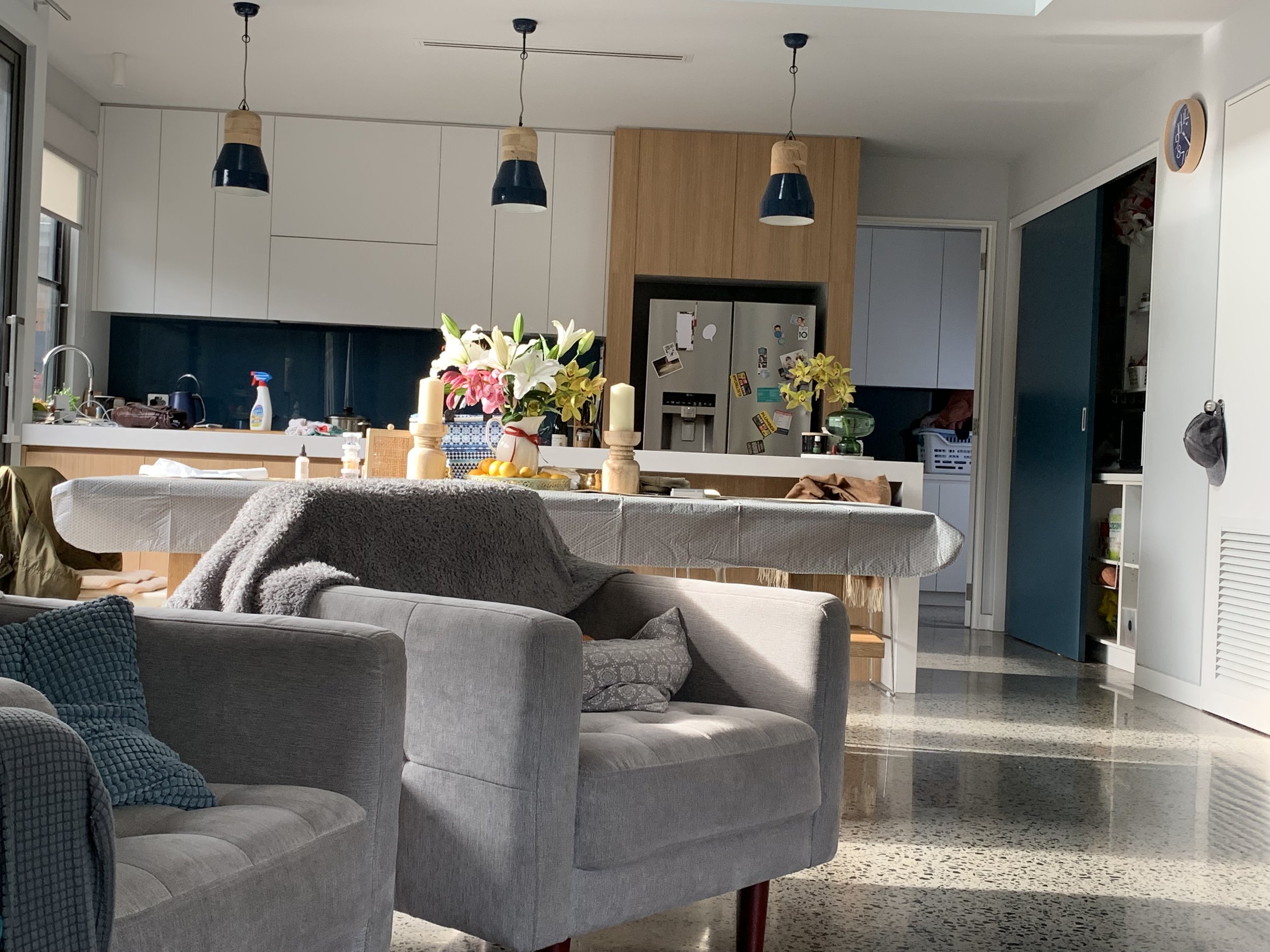
Our living area. It is west facing but captures the light and heats up the floor in winter. We also have double glazing. While concrete is often not the most environmentally friendly product to make, being very carbon-intensive, it does have a number of benefits. Concrete is a great example of thermal mass, helping to store thermal energy, and it’s very hard-wearing, so it requires very little maintenance and has a very long lifespan.
2. The verandah - a verandah is a great way of shading an area, and protecting it from the elements. We use it in part to escape the heat but also to provide a sheltered sitting area.

3. Use local materials where you can. With the short supply of materials in the building industry at the moment, those who have chosen locally sourced materials will be in front. Using local resources is typically a more sustainable option as they are native to the region, sometimes renewable, and reduce the energy that is required to transport goods long distances. If you’re designing or renovating a house, consider what materials are native to your region to create a house that is not only more sustainable, but also more in harmony with the local landscape. Sandstone has been a building block of Australian architecture for more than two centuries, its strength and durability outlasting many other construction materials. Rammed earth is easily accessible and is naturally cool living environments provide a reprieve from the extreme temperatures of the hotter regions.

Rammed earth project under construction
4. Plant a tree or two. Planting trees and gardens not only enriches your environment but can add to shade, atmosphere ad even your table with fresh herbs and veggies. Sometimes you need to remove trees or gardens to create a design but plantings are very important and give so much back to the habitat. We have a circle of trust that we often have our breakfast in and give us a lovely outlook from our living area. We also have a water bladder under our deck to capture rain run off and grey water from our washing machine to water our veggie patch.

The circle of trust garden area.
5. Lamps and skylights instead of main lights. We use lamps where we can instead of moonlights. Not only does it set a better mood but it also is far more energy-efficient. Even on a cloudy day our sky lights in the hall and.

Hallway skylights. Also has automatic blinds which we can close to shut out the hot sun.
6. Find local trades. Working with trades in your local area will assist you with so many elements of your build. We also try and find local suppliers and trades for each job we do to keep the money in the community and because they generally understand what works with the council and how to build efficiently.
Hampton a family renovation
I thought I would profile the Hampton lookbook on this blog. This home was done several years ago now and just sold for well over $3.4 million dollars.

Working with the own owners on this project was really rewarding. This was a family home in Hampton that needed a big face lift and extension. The clients were very open to my ideas and together we created a beautiful family home that they have enjoyed for many years.

Modern Kitchen. It had it’s own seperate butters pantry.
Here is the recent advertisement for the home in Real Estate.com.au

Design for Hampton Home
Green living walls
Bringing the outside in has been a feature of the Australian housing market for some time. We like to be surrounding by nature and our climate means that we can have big open spaces that face our open spaces like our gardens. However now I have noticed the trend to make living green walls part of the architecture of the home. Living green walls have become a feature that many home lovers are getting on board with.

What use to be confined to a commercial use in foyers and window dressings are now making their way into our homes.They’ve recently become some of the most striking and important eco-friendly features in buildings across the world.

When vertical gardens are used on the interiors of buildings, they can help improve air quality not only because plants naturally remove carbon dioxide and produce oxygen-rich air, but also because plants can filter the air around them by absorbing and cleaning pollutants. When they’re used inside, living green walls frequently act as a three-dimensional, living piece of artwork, providing an aesthetic component as well as a health element.

Where there isn’t the inclination to look after a living green wall some have opted for a mural or wallpaper which gives the illusion of a green space as a backdrop to a room.
My wife is a big advocate of garden and green spaces and so I am encouraged to think more about green spaces when designing homes, especially in tight spaces where a touch of green can really make the space come to life.

Eco house renovating ideas
Learning to create “green homes”
Read MorePicking the right light?

Lighting is often the last part of a project that a client thinks about, however I am always designing to maximise the natural light. Lighting really has a functional and a ambient purpose and so it is worth consulting a lighting expert when designing your home. Picking the right lighting feature is dependant on function and personal tastes. Here are some tips to follow:
Pulling the design together. Sometimes the lighting is simple and understated and sometimes it is the key to pull the design together. Working with colour, shape and size a light is a chance to draw attention.
Frame a space - a lighting feature can frame a space, like a dining room or a reading nook.
Lights can be invisible - but still create drama. Track lighting or LED under a bench or staircase and can really set a mood in the evenings.


4. Colour and materials - are really a chance to show off your style, especially in the kitchen and bathrooms.

